Brand visibility no longer depends solely on traditional search rankings. AI systems have become the new gatekeepers, deciding which brands surface in answers and which get systematically filtered out. With 60% of Google searches now ending without a click to a website, the rules of digital marketing have fundamentally changed. Your brand’s survival depends on understanding how AI systems evaluate, select, and present information to users.
The AI Revolution: Why Traditional SEO Still Matters
Despite widespread claims that AI will replace search, SEO remains foundational—it’s simply evolved. Modern SEO isn’t just about ranking pages; it’s about ensuring your brand exists in the data layer that AI systems rely on for training and answers. Research shows that 94% of Google AI Overviews cite at least one top organic result, proving that traditional search signals still underpin AI outputs.
The core SEO principles—crawlability, indexability, structured data, and authority signals—have become more critical than ever. Without these fundamentals in place, LLM SEO systems will eliminate your brand from conversations entirely. Your website now serves as both a destination for users and a training manual for AI systems learning about your industry and expertise.
Avoiding the ‘Meh Tax’: Why Generic Content Gets Ignored
AI systems have developed what experts call a ‘meh tax’—an invisible penalty that affects generic, repetitive content. When your content feels average or indistinguishable from competitors, AI systems either filter it out entirely or summarize it alongside similar content, stripping away your brand attribution in the process.
This penalty manifests in three devastating ways: your brand identity gets erased in AI-generated summaries, your content gets classified as low-value, and your work becomes free training data for AI without providing any visibility benefits. The consequence is clear—brands that fail to differentiate themselves risk becoming invisible in an AI-driven search landscape.
The Three Pillars of AI Visibility
Success in AI-powered search depends on mastering three critical signals that determine whether your brand gets chosen or ignored. Entity authority requires AI systems to recognize your brand as a trusted source on specific topics. This authority stems from consistent brand demand—if people aren’t actively searching for your brand, AI systems won’t prioritize you either.
Information density and originality represent the second pillar. AI systems prioritize content that contributes new facts, proprietary data, original research, and unique perspectives. Brands that consistently publish original insights can boost their visibility by 30-40% compared to those recycling existing information.
Signal alignment forms the third pillar, where AI evaluates not just what you say about your brand, but what others say about you. This includes customer reviews, social media discussions, media coverage, and community conversations. Conflicting signals across these channels can flag your brand as unreliable, while consistent messaging creates a ‘consensus signal’ that AI systems trust.
The Organizational Challenge: Breaking Down Silos
Most organizations aren’t equipped for AI-driven visibility because responsibility remains fragmented across departments. SEO teams focus on rankings, PR teams manage messaging, and growth teams run experiments—but no single team owns visibility across AI systems. This fragmentation leads to inconsistent signals and missed opportunities.
Traditional performance metrics are also breaking down. Many brands experience stable rankings alongside declining traffic, yet see increased leads with unclear attribution. This disconnect occurs because AI systems use content without sending users back to the original source, creating a growing gap between impact and measurement.
From Rankings to Relevance: The New Competitive Landscape
Competition has shifted from fighting for search positions to competing for inclusion in AI-synthesized answers. Users spending more time in conversational AI environments means higher-intent interactions—consumers who use LLMs convert 4.4 times higher than those using traditional search alone. However, this also means brands must earn their place in a more selective, AI-curated information ecosystem.
Authority in this new landscape depends heavily on external validation rather than just published content. AI systems evaluate what others say about your brand across multiple platforms, making third-party endorsements and community discussions more valuable than ever for establishing credibility and trustworthiness.
Winning Strategies for AI-Powered Search Success
- Build genuine authority in a focused niche through consistent, expert-level content and thought leadership
- Publish original, high-value content that contributes new facts, data, or perspectives to your industry
- Align messaging across every platform and channel to create consistent signals for AI systems
- Earn third-party validation through customer reviews, media coverage, and community engagement
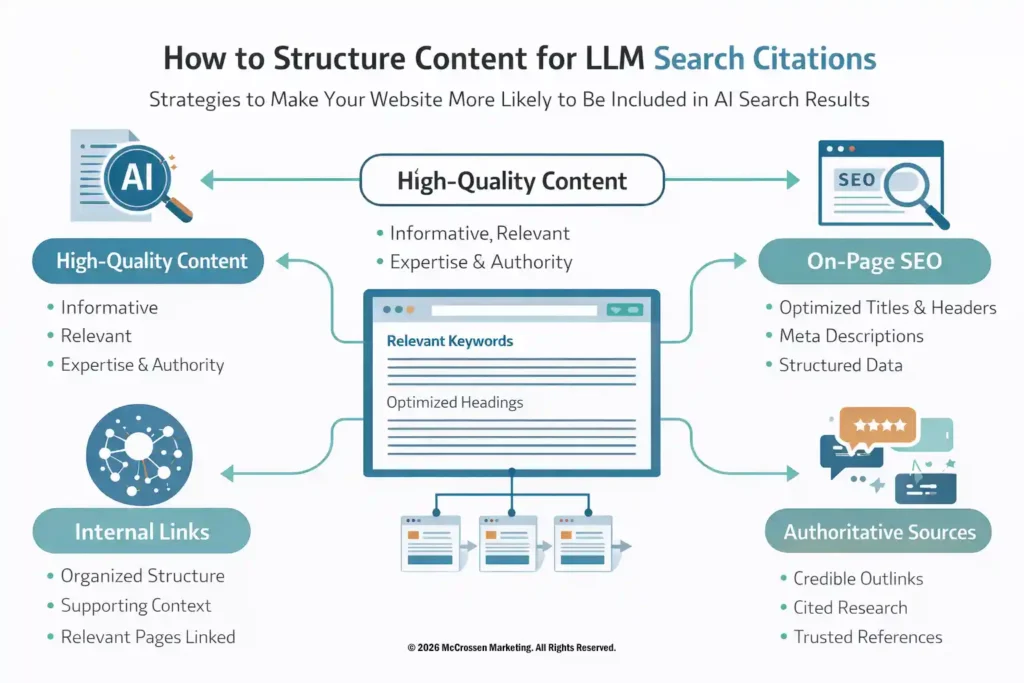
- Implement comprehensive SEO fundamentals to ensure AI systems can discover and index your content
- Monitor and measure brand mentions across AI platforms to understand your visibility footprint
- Create content that serves both human readers and AI training while maintaining authenticity and value
The brands that thrive in an AI-driven search environment will be those that make it impossible for LLM SEO systems to ignore them. This requires a fundamental shift from optimizing for algorithms to building genuine authority, creating original value, and maintaining consistent excellence across every touchpoint. McCrossen Marketing helps businesses navigate this transformation by offering a Marketing Intelligence Operating System with tools that help small businesses align traditional SEO excellence with AI-era visibility requirements. The future belongs to brands that understand AI isn’t just changing search—it’s deciding which businesses survive and thrive in the digital marketplace.