Did you know Google killed FAQ rich results on May 7? If you’ve been managing structured data for any commercial site, you probably already noticed your accordion snippets stopped rendering. The Search Console reporting goes away in June, and the API support is gone by August.
Should we rip out the FAQ schema? Google killed it, so it’s done, right? In my opinion, no, and the reason is the part of Google’s deprecation notice that almost nobody is quoting back: “Google will continue to use FAQ structured data to better understand pages.”
The display feature is dead. The data isn’t. And if you read what’s happening on the AI side of search, the data probably matters more in 2026 than it did when rich snippets were the headline feature.
What this looks like in client work
Data-backed decision-making is the frame I use with clients. Here’s a small example from this week.
One of our legacy agency-model clients (we don’t advertise that style of work anymore, but we still do it for long-standing accounts) runs a page that recently landed in the top five SERP positions for a regional keyword. The page has no FAQ section and no FAQ schema. Despite Google’s deprecation announcement, the data still pointed to an opportunity.
Three reasons. First, a concise FAQ on appropriate pages usually improves conversions. Second, my client spends less time fielding the top three to five questions by email and phone when those answers live on the page. Third, more structured data for traditional search engines and now LLMs is better to have than not. The FAQ that would help the client’s direct customers also serves the broader Texas and broader regional audience landing on this page.
Three extra sentences in this week’s client report flagged the opportunity. Half a day to implement, including stakeholder back-and-forth. Not an industry-shattering discovery, just one more small move on a page already performing well, which is exactly the kind of work the FAQ schema deprecation does not change.
This wasn’t sudden
The May notice is the last beat in a phaseout that started August 2023, when Google quietly restricted FAQ rich results to “well-known, authoritative government and health websites.” For commercial sites, the visible feature had already been gone for almost three years. Most teams I work with had stopped looking at FAQ rich-result reporting in Search Console by mid-2024 anyway. There was nothing to look at.
Google has been politely vague about why. The practical answer is that the feature was abused into uselessness. By 2022 you couldn’t open a pricing page on the internet without finding a templated FAQ block at the bottom, full of fake questions answered with sales pitches. Google was either going to spend significant resources policing what counted as a real FAQ, or kill the visible feature and use the markup quietly in the background. They picked the second option.
AEO and GEO, briefly
Two acronyms you’ll see everywhere in 2026 SEO writing:
AEO, Answer Engine Optimization, is structuring content so that an answer engine can extract a direct answer and present it. This generally covers:
- Snippets
- Voice assistants
- Knowledge panels
- Google’s AI Overviews
The assumption is that the user wants the answer, not ten links to evaluate. AEO treats your page as a source of the answer.
GEO, Generative Engine Optimization, is structuring content so that a large language model synthesizing an answer from multiple sources will cite yours. Examples:
- ChatGPT
- Claude
- Perplexity
- Gemini
- Google’s AI Mode
The user gets a generated response, and your job is to be one of the sources named behind it.
My take on the current landscape: the AEO/GEO distinction is mostly marketing. The actual content moves are the same. Write tight, structured, factually clean question-and-answer pairs. Mark them up. Make sure visible text and machine-readable data agree. Andreessen Horowitz coined GEO in a thesis last year and a lot of agencies adopted it because it sounded new. AEO is older and clearer. Pick whichever term your team prefers. The work doesn’t change.
What actually changed: from CTR hack to citation pathway
The old playbook everyone learned in the rich-snippets era was simple. Ship FAQ schema, get the accordion in Google search, capture more pixels, win the click. That game is over for 99% of sites.
The new playbook isn’t as visible, but it’s working. Pages with clean FAQPage markup show up in Google’s AI Overviews at notably higher rates than equivalent content without it. The same is true (to varying degrees) for ChatGPT, Perplexity, and Gemini. Industry studies put the lift somewhere between 2x and 4x depending on methodology. I take all of those numbers with some salt because the field is too new for clean data, but the directional finding holds consistently enough across sources that I trust it.
There’s a wrinkle worth knowing about, though, and it changes the prescription.
A controlled experiment by Mark Williams-Cook earlier this year showed that LLMs don’t actually parse JSON-LD as structured data. They tokenize it as raw text along with everything else on the page. In his test, ChatGPT and Perplexity successfully extracted data from intentionally invalid, made-up schema, which proved they were reading the script block as plain characters and not validating its structure.
So, the FAQ schema isn’t doing the work directly inside the language model. The visible Q&A content on your page is. The schema is doing two other things: feeding Google’s Knowledge Graph (which improves your organic visibility and therefore the retrievability of your page in AI search), and signaling to crawlers that the page is intended as Q&A content even when the visible HTML is sloppy. Both effects matter. Neither replaces the other.
The rule that follows from this: if you’re shipping FAQ schema, your page also needs visible Q&A content that matches the schema almost word-for-word. The schema-without-visible-content move that worked in 2019 is actively harmful now. Google will flag the mismatch, and the AI systems will extract whatever non-Q&A text is actually on the page instead of the content you wanted them to extract.
How to ship FAQ schema well in 2026
A few rules of thumb that have held up across the audits I’ve done in the past year.
Match the visible page text to the schema text, exactly. Older FAQ plugins drift over time because the visible HTML and the JSON-LD are stored and edited separately. Someone updates a typo in the visible content, the schema doesn’t update with it, and six months later you’re misaligned and don’t know it. The fix is structural: drive both outputs from a single source so they physically can’t drift.
Keep answers between 40 and 60 words. This is the sweet spot for AI extraction in 2026. Two to four sentences, self-contained enough to be quoted standalone. Shorter than that and AI systems pad them out (badly). Longer and they truncate.
Use real questions, not marketing fluff. The FAQ abuse pattern that killed rich snippets, fake questions to hold pixel space, is the same pattern AI systems have learned to deprioritize. Real questions come from Search Console (the phrases people actually typed before landing on your page), sales call recordings (the question every prospect asks around minute 12), support tickets, and a useful trick: ask ChatGPT and Perplexity what someone evaluating your category should ask. Whatever they generate is exactly the question your buyers are already asking them.
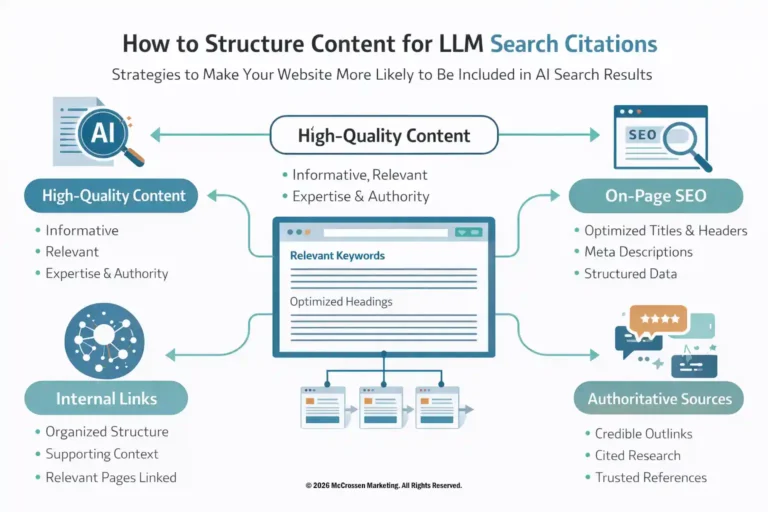
Stack FAQPage with other schema types. FAQPage rarely earns its place as the only structured data on a high-value page. A product page should carry Product plus FAQPage. A local service page should carry LocalBusiness plus Service plus FAQPage. A long-form guide carries Article plus BreadcrumbList plus FAQPage. Multiple schema types on a single URL give AI systems a richer entity map of what the page is for, and that’s what citation algorithms reward.
Validate before you publish. Google’s Rich Results Test still validates FAQ markup until June, after which the schema.org validator at validator.schema.org is the canonical tool. Most broken implementations I see in audits are trivial errors that either tool surfaces in two seconds.
Should every page have FAQ schema?
No. The urge to do that is exactly what killed the rich result in the first place.
Here’s the test I use with clients. If you wouldn’t naturally put an FAQ section in a printed brochure or sales deck for this page’s audience, don’t bolt one on for the schema. The shape of useful FAQ content is determined by where the buyer is in their decision, not by which URL you happen to be marking up.
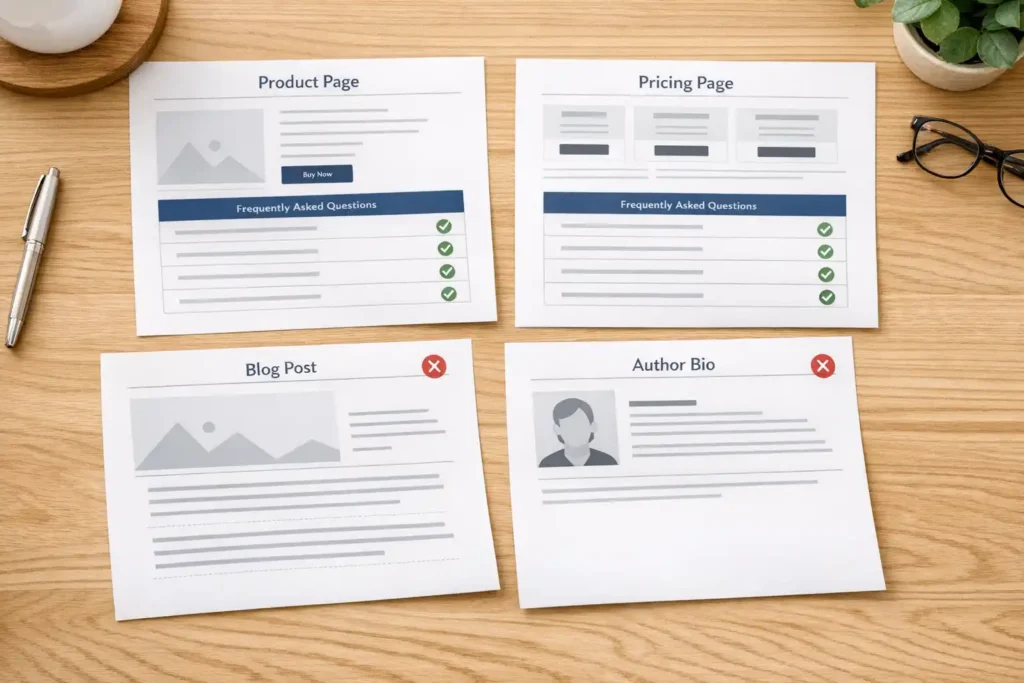
Pages that earn FAQ schema: product and service pages (buyers ask about pricing, fit, returns, timelines, qualifications), comparison pages, pricing pages, onboarding and setup guides, high-intent landing pages where ad traffic arrives mid-decision, local business pages with geography or licensing questions.
Pages that don’t: generic blog posts that aren’t structured as Q&A, top-of-funnel awareness content where the visitor doesn’t have specific questions yet, archive and tag pages, author bios, and usually home pages.
A small number of well-built FAQ pages, each anchored to a real buyer moment, will out-cite a hundred templated blocks every time. That ratio has held up across every site I’ve worked on this year.
Where the McCrossenSEO™ WordPress SEO Plugin Lands on This
McCrossenSEO™ ships clean JSON-LD for the schema types AI search engines actually use to build entity understanding: Article, WebPage, Product, LocalBusiness, BreadcrumbList, Organization. The plugin doesn’t auto-bolt templated FAQ blocks onto pages that don’t have real questions on them. That’s deliberate. Plugin-level templated FAQ is what created the 2020-2023 schema abuse problem in the first place, and I’m not interested in reproducing it inside the McCrossen ecosystem.
Where real Q&A content does live on a page, FAQ schema is driven from the same content source as the visible HTML, so the two physically can’t drift apart. That single-source pattern is what keeps you safe when AI platforms verify schema-text against visible-text, which they increasingly do.
What I’d do this month
Three things before June, when the FAQ Search Console reporting goes away:
Export your historical FAQ rich-result data out of Search Console before the report disappears. Even if you have no immediate use for it, you’ll want the baseline later if you ever need to demonstrate the shift from rich-result traffic to AI-referred traffic. Once the report is removed, you can’t retrieve the data.
Audit every page on your site that currently ships FAQPage schema and verify the visible page has matching Q&A content. The pages where the two don’t agree are your silent failures. Either add the visible content or remove the schema.
Pick your five highest-intent pages, top product, service, and pricing pages, and write three to seven real buyer questions for each with 40-60 word answers. Ship them as visible content and as schema, driven from a single source.
The McCrossen Marketing platform is a great resource to assist you here. The Document Builder can help you draft question sets, and the McCrossen Marketing AI Advisor can help surface what customers in your category are asking.
That’s the whole list. Don’t strip the schema you already have, don’t paste it onto pages that don’t deserve it, and tune what you have to match how the engines reading it have changed.
Matt McCrossen is the founder of McCrossen Marketing, a veteran-owned SaaS platform building AI-era marketing infrastructure for small businesses. McCrossenSEO™ is a free SEO plugin that ships clean structured data for the search and AI-search era.